Food Guides
Konbini Oden: Why the Pot Disappeared (And What's in the Cup Now)
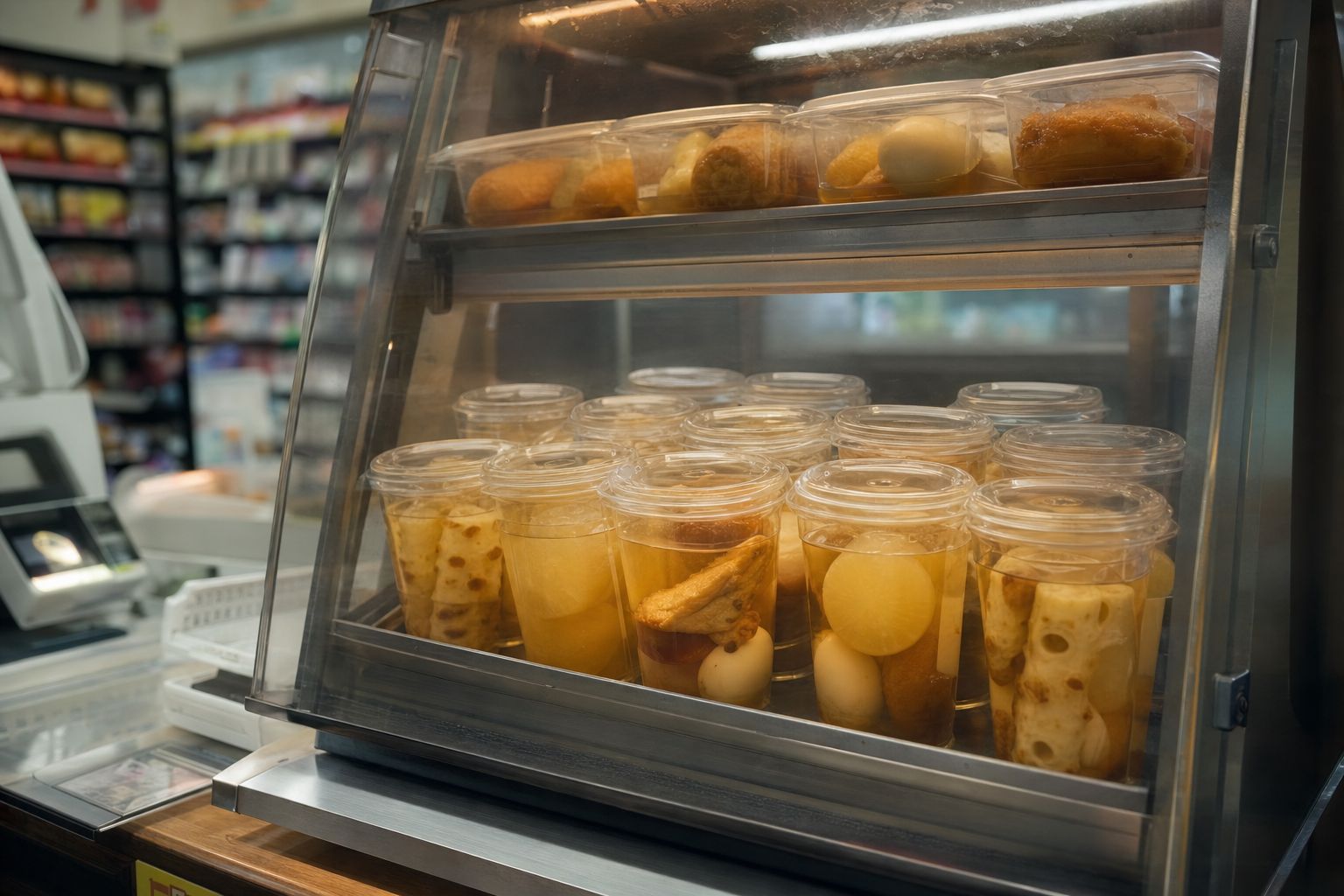
Ask anyone who visited a Japanese convenience store before around 2020 what they remember about oden, and they’ll describe the same thing: a steel pot simmering by the register, a pair of tongs, a stack of paper cups, help yourself to whatever’s floating. I went looking for that pot at four different chains near my office last winter. I found exactly one, at a FamilyMart, and even that location only had it running some of the time.
The short version: self-service oden pots are disappearing from Japanese convenience stores, replaced mostly by sealed, pre-cooked cups you grab straight from a chiller case. It’s not a discontinuation — oden season is still very much happening, and this year’s lineup is rolling out right now, Lawson’s new batch landing this week. It’s just a different format than the one most guides still describe.
Why the pot went away
The shift isn’t really about taste. A few things converged at once. Heightened hygiene sensitivity around shared serving utensils made customers warier of a pot anyone could dip tongs into. Running one properly is also a lot more labor than it looks — staff I’ve talked to put the daily setup and cleanup at an hour and a half to two hours, on top of monitoring broth temperature and pulling out whatever’s sat too long. And oden left in a pot too long is oden that gets thrown away at closing, which is a cost every store owner eventually starts doing math on.
A 2024 survey by the site SoraNews24 checked thirteen stores across four major chains in one Tokyo neighborhood on Oden Day (a real, if minor, Japanese food holiday). Most had no pot at all. A few sold a chain’s own packaged, pre-cooked version in a cup instead. FamilyMart was the one chain still running actual pots at some locations — but even there, only about half the stores they checked had one going.
None of this means oden is fading out. If anything the packaged format solved the format’s oldest problems — sealed portions don’t sit under heat lamps all day, and stores can stock a consistent product instead of gambling on what’s left in the pot by 9pm. It’s just a quieter, less theatrical version of the same food.
What’s actually on shelves this week
Oden season runs roughly September through late winter. Lawson’s 2026 lineup started rolling out September 23, and 7-Eleven is still serving the broth and ingredient overhaul it rolled out the previous fall — a tara (cod) dashi added on top of the usual bonito and kelp, plus a reworked five-ingredient colorful ganmodoki (a fried tofu-and-vegetable patty) and a bulked-up wiener-maki.
| Chain | What’s in the case | Price |
|---|---|---|
| 7-Eleven | Five-ingredient colorful ganmodoki | ¥121 |
| 7-Eleven | Wiener-maki (sausage wrapped in a fish-paste roll) | ¥139 |
| Lawson (from Sept. 23, 2026) | Broth-soaked daikon, broth-soaked egg | ¥160 each |
| Lawson (from Sept. 23, 2026) | Beef tendon (gyusuji) | ¥198 |
| Lawson, Okinawa stores only | Tebichi (stewed pork trotter) / soki (pork rib) | ¥289 / ¥270 |
| Lawson Store 100 (from Sept. 23, 2026) | Full “100-yen oden” line, 11 items including chikuwabu | ¥108 each |
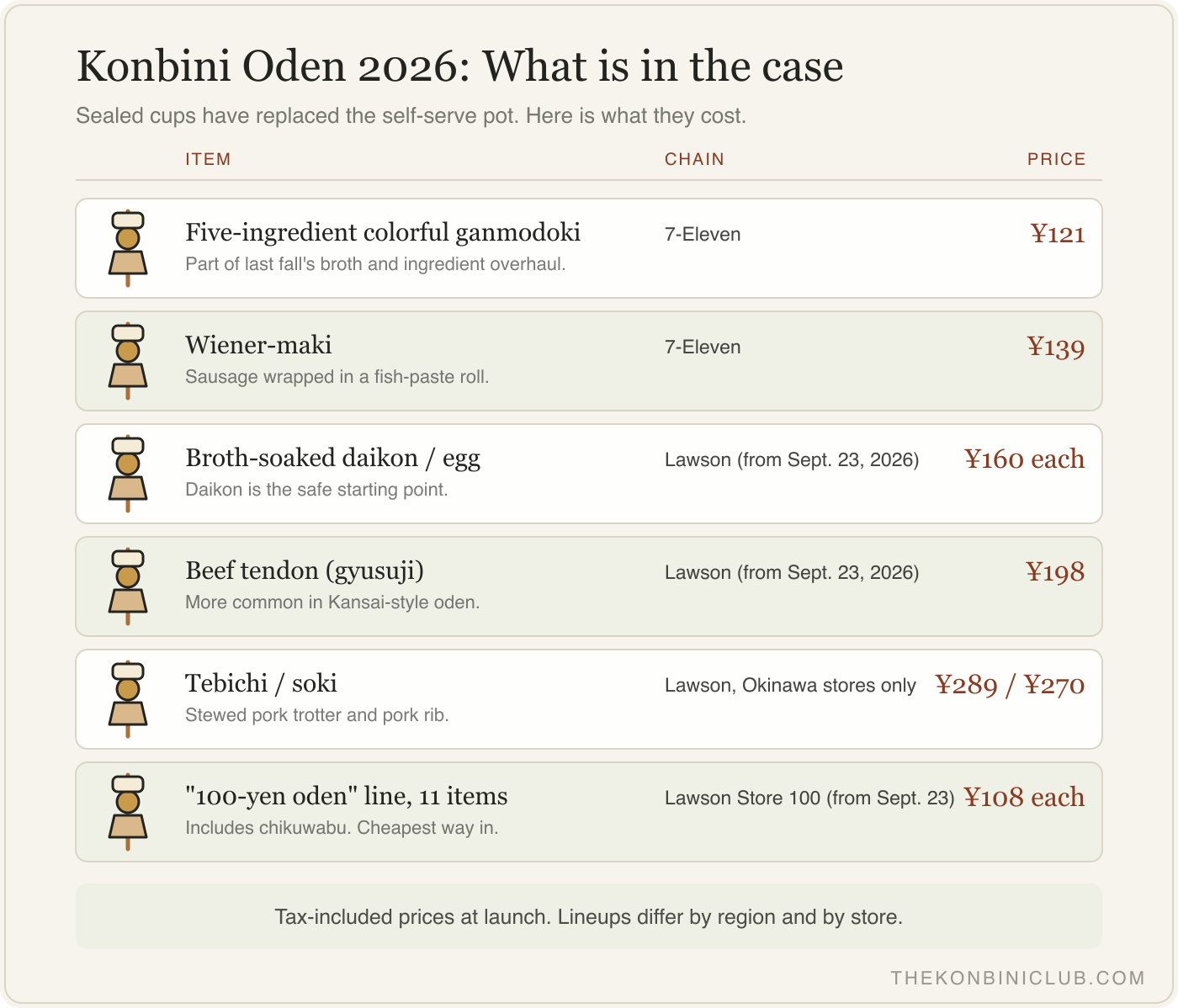
Lawson’s regional split deserves its own mention: tebichi and soki only show up at Okinawa locations, which is a small but real example of how much these chains quietly localize a supposedly national menu. Lawson Store 100’s flat ¥108 line is the cheapest entry point by a wide margin if you just want to try a couple of pieces without committing to a full meal — and it’s also, conveniently, where the next section’s ingredient shows up.
The ingredient your friends have never heard of
Buy a mixed oden set anywhere in Tokyo and there’s a good chance one piece will be a pale, ridged, hollow-centered cylinder that isn’t fish cake, isn’t tofu, and isn’t quite anything a first-timer can place. That’s chikuwabu — wheat flour kneaded into a dough and steamed into roughly the shape of chikuwa (the actual fish-paste tube it’s named after and modeled on), originally developed as a cheaper stand-in back when fish surimi cost more.
Here’s the part that surprised me: chikuwabu is a Kanto thing. People from Tokyo and the surrounding region grow up treating it as a normal oden piece — it’s one of the eleven items in that Lawson Store 100 line above. Go to Kansai and plenty of people have genuinely never encountered it.
I grew up in Gunma, firmly on the Kanto side, and my wife is from Kyoto, so we run into this kind of split constantly. Her New Year ozoni has round mochi in a miso broth; mine had square mochi in a clear, soy-seasoned one. Even tamagoyaki splits: sweet where I grew up, dashi-style on her side.
Oden is no exception. Tokyo-area oden leans on a bonito dashi broth darkened with soy sauce; Kansai versions tend toward a lighter kelp-based broth. Kansai oden also shows up more often with beef tendon, octopus, and hirousu (a fried tofu patty) — ingredients that barely register on a Kanto shelf.
A “national” food, it turns out, is really several regional ones wearing the same name.
What to actually order
Daikon is the safe starting point — simmered for hours until it’s gone translucent and soaked all the way through with broth, soft enough to cut with a spoon. If a piece of oden is going to convert someone who’s skeptical of “vegetables that have been boiling all day,” it’s this one. The flaw: grab one too early in a batch, before it’s had real time in the broth, and it’s bland in a way that undersells the whole category — daikon is the ingredient most dependent on patience, not skill.
Hanpen — a light, almost foam-textured fish cake — is the other beginner-friendly pick, mild enough that it works as a palate reset between the saltier items.
My honest opinion, and this one gets disagreement every time I say it out loud: skip the boiled egg unless the broth has clearly been running a while. A fresh pot (or a cup that’s only just been portioned) gives you an egg that tastes mostly of egg with a faint broth note. Give it time to actually take on the shimishimi quality — a word Japanese cooking uses for something soaked all the way through, not just seasoned on the surface — and it’s a completely different item. The packaged format, to its credit, tends to get this right more consistently than an old self-serve pot ever did, since the egg sits sealed in broth the whole time instead of drying out under a heat lamp.
The one thing I won’t defend: the fish cake assortments that pack four or five different textures into one bag as a “value” pick. It reads bimyou to me — a hard word to translate cleanly, something closer to “so-so” than outright bad — because you end up with one genuinely good piece and three forgettable ones, for not much less than buying the good one on its own.
Getting the experience if you’re not in Japan
Fresh oden, packaged or not, is a same-day food — it doesn’t ship, in the same category as the fried chicken sitting in the hot case a few steps over. What you can get shipped is the building-block version: dashi packets, konnyaku, and shelf-stable fish cakes are all things a decent Japanese grocery import site carries, and our snack starter list covers where to source the adjacent shelf-stable classics if you want to build a konbini-style spread at home. If you’d rather have someone else pick the box for you, our comparison of Sakuraco, TokyoTreat, and Bokksu is the place to start, though none of the three run oden kits specifically — it’s too perishable a category for that format.
The pot is gone, or close enough to gone that I wouldn’t plan a trip around finding one. What’s replaced it is quieter and, if I’m honest, more reliable — you know exactly what you’re getting before you open the lid, which is more than I could say for whatever had been sitting in that pot since lunch. I’ll still take the cup over nothing. Just don’t go in expecting the tongs.
— Sen
The Konbini Hit List (Free)
The 25 snacks Japanese people actually buy — printable, with what to order online when you can't fly to Tokyo.
Get the hit list →