Ice Cream Guides
Japanese Convenience Store Ice Cream: The Freezer Case Locals Actually Raid
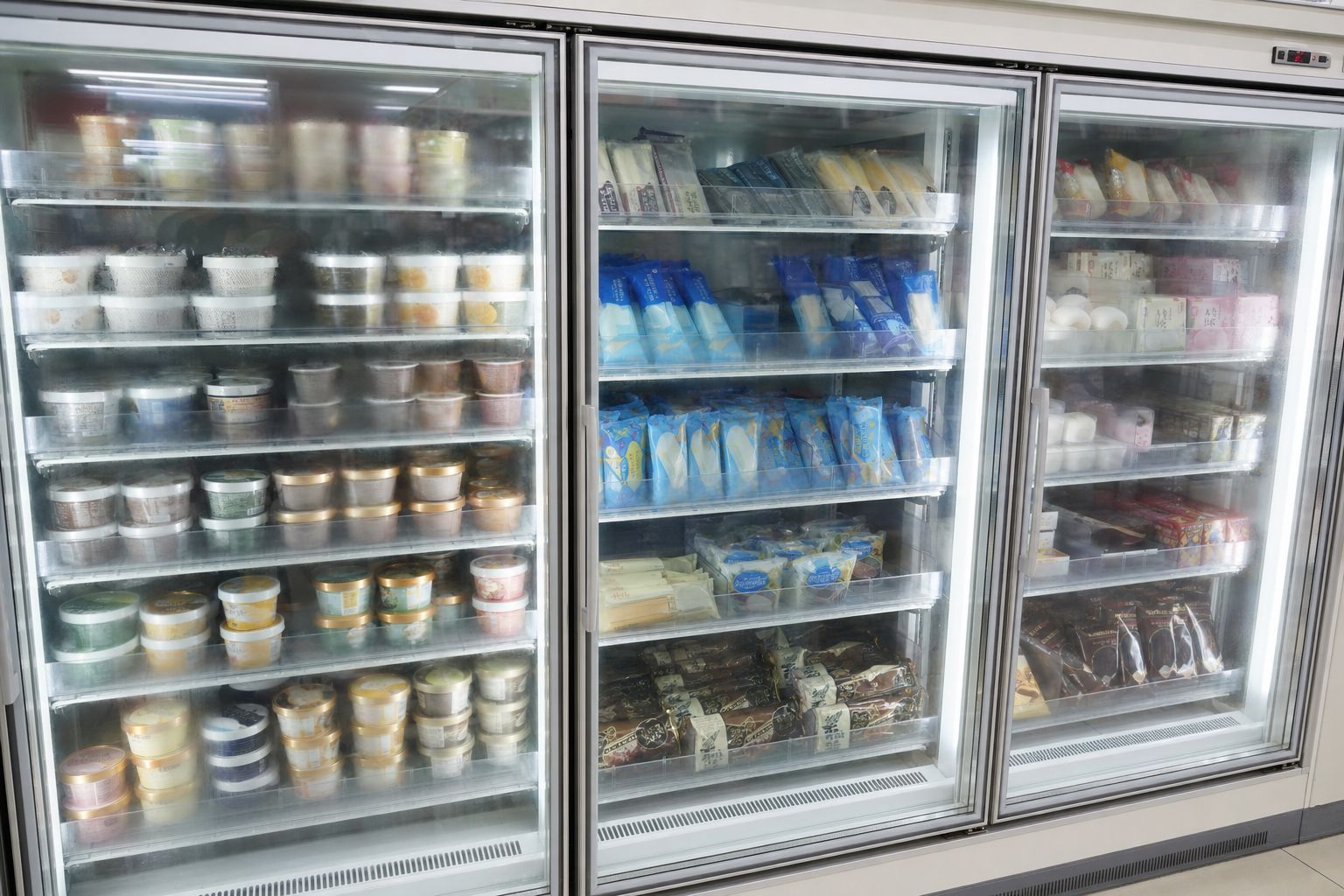
Most snack box roundups skip the freezer case entirely, and that’s a mistake. It’s colder, it turns over faster than any other shelf in the store, and — this is the part nobody mentions — it’s where a lot of Japanese people actually spend their convenience store money in summer, more than on chips or chocolate.
The short answer: if you only try three things, get a Häagen-Dazs mini cup in a flavor you can’t buy at home, a box of Lotte’s Yukimi Daifuku for the mochi shell, and a Garigari-kun soda pop for ¥97 just to understand why a ten-yen price change once made international news. Everything past that is refinement, and refinement is most of what follows.
Why the freezer case is the honest read on a konbini
Shelf-stable snacks can sit in a warehouse for months before they reach a store, which means the snack aisle mostly reflects what sells nationally, not what’s popular this week. Ice cream can’t do that. It has to move fast or get pulled, so what’s actually stocked — and restocked — tells you what people are buying right now, not what a marketing calendar decided six months ago.
I’ve written before that Lawson’s dessert case is the most slept-on shelf in a Japanese convenience store, and the freezer next to it is arguably even better. It’s also the one category, along with our tamago sando write-up, that a snack box genuinely cannot ship you. Dry ice buys you maybe a day. This is a category you either try here or skip.
What’s actually in the case
Häagen-Dazs mini cups
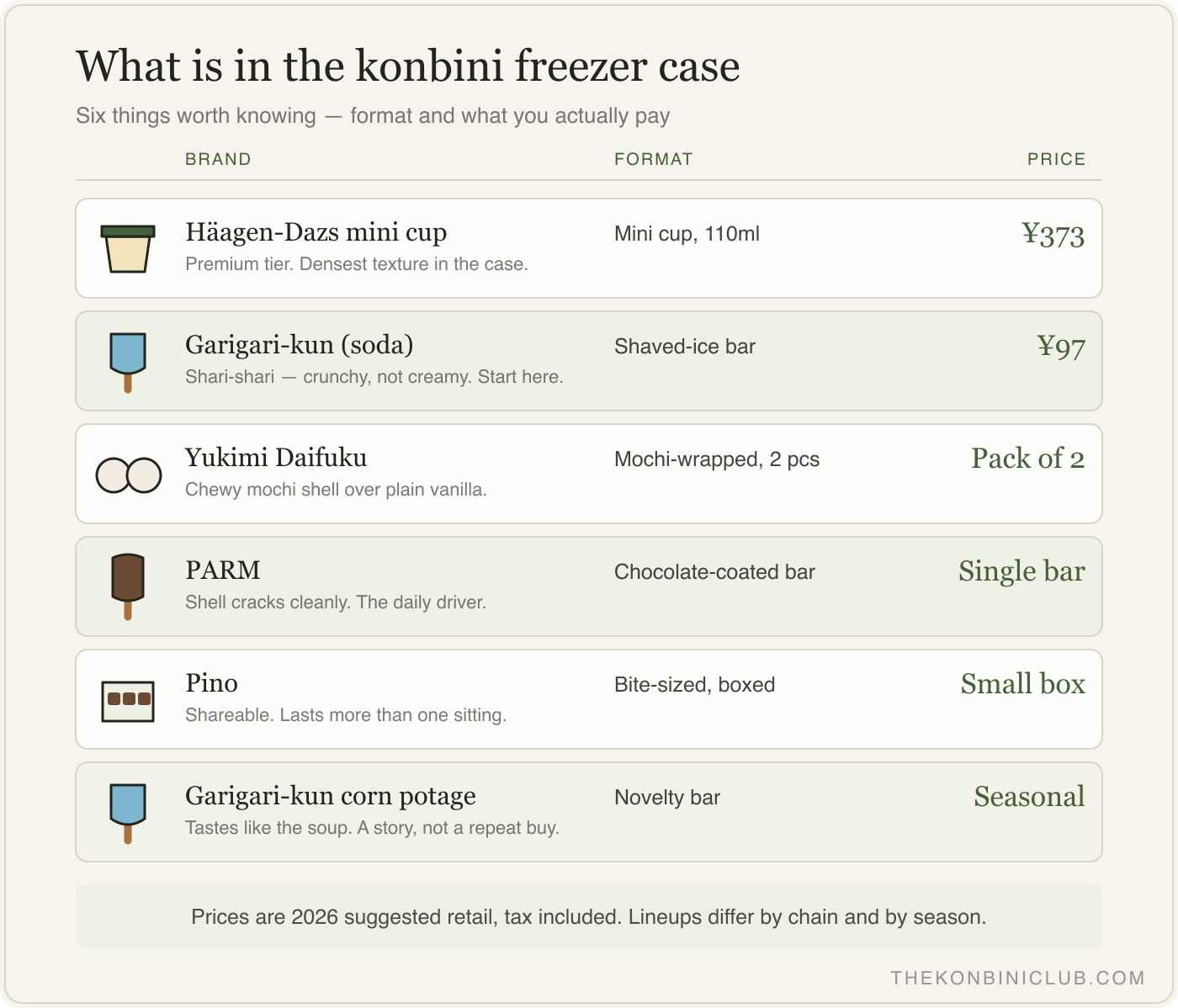
These are the premium tier, and every konbini in the country carries a rotating handful of flavors. Vanilla and green tea (matcha) are the standing lineup; seasonal ones like a hojicha-and-kinako combination show up and disappear within a few months, which is part of the appeal — if you see one you don’t recognize, that’s the signal to buy it now.
I always reach for the green tea one, and I’ll admit that’s not exactly objective reporting — I’m also the guy who orders a matcha latte at Starbucks more often than plain coffee.
But it’s not just me. Lawson in particular has built a reputation for its chilled dessert case punching above what a convenience store should be able to do, and the matcha items are usually the first to sell out on a hot day.
As of this year, a mini cup runs ¥373 at the register (Häagen-Dazs Japan raised its suggested retail price in March 2026, its first hike since 2023). That’s genuinely expensive for 110ml of ice cream — a supermarket multipack works out cheaper per cup, if you’re buying more than one or two. I still think it’s worth it exactly once per flavor, because the texture is noticeably denser than anything else in the case. Past that, it’s a treat price, not a stock-up price, and I budget for it that way.
Garigari-kun
The opposite end of the spectrum, and the one with the better story. Garigari-kun is a shaved-ice pop on a stick, made by Akagi Nyugyo, and the standard soda flavor is ¥97 as of the March 2026 price revision. That sounds like a small number to fuss over, but the last time Akagi raised the price — April 2016, from ¥60 to ¥70, its first increase in 25 years — the company put roughly a hundred employees in a line outside its head office to bow on camera for a nationwide apology ad. The New York Times and the BBC both covered it. A ten-yen ice pop hike became a story about Japanese deflation and corporate humility, which is a strange amount of cultural weight for something that costs less than a coin-locker key.
Garigari-kun also has a habit of releasing flavors that shouldn’t work. The corn potage version, launched in 2012, is the famous one — it’s said to taste close to the actual soup, and it sold well enough that Akagi kept bringing it back. I’ve tried it exactly once, out of obligation more than curiosity, and my honest opinion is you can skip it. It’s a curiosity more than a dessert — buy soda or the seasonal fruit flavors instead and leave the corn potage as a story to tell rather than a repeat purchase.
Yukimi Daifuku
Small mochi-wrapped vanilla ice cream balls from Lotte, sold two to a pack, usually sitting near the register in a small chilled bin rather than a standing freezer. The mochi shell stays chewy instead of freezing solid, which is the entire point — bite through a slightly resistant, faintly sweet shell into plain vanilla ice cream, and the contrast is the whole reason this has stayed on shelves for decades. There’s a “choco saku-saku” version that shows up seasonally too, with crunchy chocolate puffs mixed straight into the mochi shell instead of a coating, but the plain one is still the one to start with.
PARM and the chocolate-shell bars
Morinaga’s PARM is a chocolate-coated ice cream bar, and it’s the closest thing this category has to a daily-driver snack, the kind of thing salarymen grab on the walk back from the station on a hot evening rather than save for somewhere special. The shell cracks cleanly instead of shattering into your shirt, which matters more than it sounds like it should when you’re eating one standing up on a train platform.
Pino
Despite the fancy-sounding name, it’s also a Morinaga product, easy to mix up with Häagen-Dazs if you’re new to the shelf. Pino is bite-sized chocolate-coated ice cream pieces sold in a small box, closer to a shareable snack than a single-serving treat. It’s the one I actually keep in my own freezer at home, because a box lasts through a few evenings instead of disappearing in one sitting.
Coolish, the one you drink
The format oddity of the case, and the reason people search for Japanese ice cream in a pouch at all. Coolish is Lotte’s frozen dessert in a soft 140 ml pouch with a screw cap. You knead the pouch until the contents loosen, then drink it instead of biting it.
It exists for one situation: eating something frozen with one hand, outdoors, with no stick to get rid of afterward and nothing melting down your fingers. Which describes a Tokyo summer commute almost exactly. The cap is the underrated part — you can stop halfway, screw it shut, and put it back in a bag. Nothing else in this case lets you do that.
Set your expectations on texture. It’s much closer to a very thick frozen shake than to ice cream, and people who go in expecting the second are reliably disappointed. Vanilla is the standing flavor and the right first purchase; coffee and fruit versions rotate through and vanish.
The flaw is the back third of the pouch. Drink it slowly and the end arrives thin and watery, so this is a five-minute product rather than a twenty-minute one. If you want something to sit down with, buy the Häagen-Dazs.
Mistakes worth avoiding
A few ways to get this wrong, in ascending order of how often I’ve watched someone actually do it:
- Buying Häagen-Dazs by the cart-load. It’s the best texture in the case, but at nearly ¥400 a cup, it adds up faster than the packaging suggests. Treat it as an occasional flavor-chasing purchase rather than a weekly habit.
- Assuming the freezer case looks the same at every chain. 7-Eleven, Lawson, and FamilyMart each carry their own exclusive flavors alongside the national staples, so the exact lineup shifts store to store and season to season. Don’t plan a trip around one specific item unless you’ve confirmed it’s still running.
- Skipping Garigari-kun because it looks like a kids’ snack. It’s shaved ice, not soft-serve, and the texture — Japanese has a word for it, shari-shari (シャリシャリ), the crunchy-crumbly sound of biting into packed ice — is genuinely refreshing on a Tokyo summer day that’s pushing 35°C. Plenty of adults in suits are buying it at the same register you are.
The honest bottom line
None of this is a secret system. It’s a freezer case that turns over fast enough to tell you, honestly, what’s selling this month — which is more than you can say for most of the rest of the store. If you’re building a wider order instead of a single trip, our snack starter list covers what travels well, and our three-box subscription comparison is the next stop if a monthly surprise sounds better than picking items yourself — though a subscription still can’t get you here what the freezer case gets you for under a hundred yen.
Start with the soda-flavor Garigari-kun. It’s the cheapest thing on this list, and it’s the one that explains everything else about how seriously this country takes its ice cream.
The Konbini Hit List (Free)
The 25 snacks Japanese people actually buy — printable, with what to order online when you can't fly to Tokyo.
Get the hit list →