Food Guides
Konbini Nikuman: Japan's Steamed Pork Bun, Explained (and Ranked)
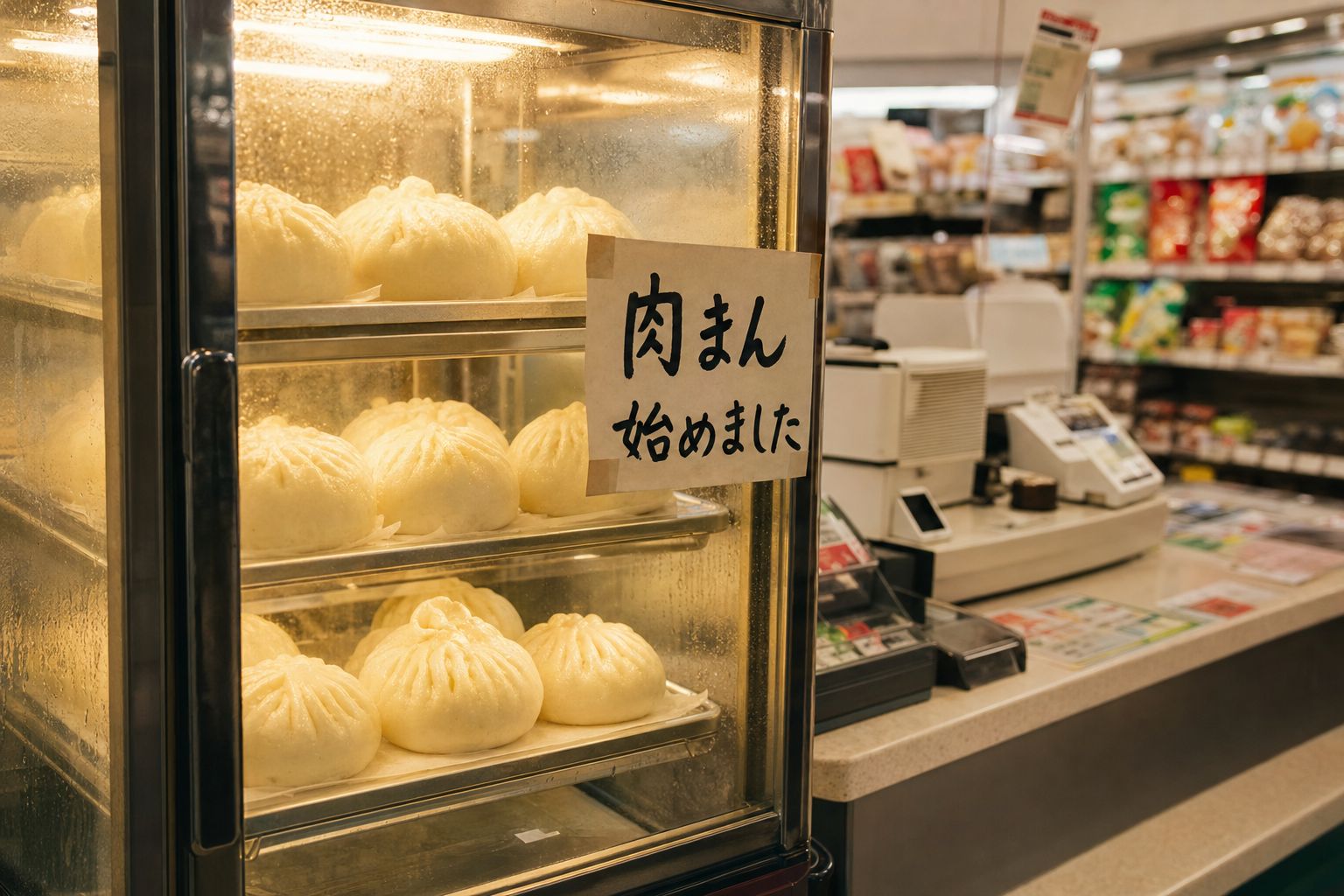
The real start of winter in Japan isn’t a date on a calendar. It’s a small heated case by the register, usually empty since spring, suddenly full of round white buns under a hand-lettered sign that just says “肉まん始めました” — nikuman has started. I notice it before I notice the temperature.
The short version: nikuman is Japan’s convenience-store steamed pork bun, sold everywhere from late summer through winter, and it comes with its own regional naming split, its own price ladder depending on how fancy a version you want, and — depending who you ask — its own correct way to eat it (spoiler: I think the correct way involves nothing extra at all).
What’s actually in the case
Nikuman (肉まん) is a steamed wheat-flour bun wrapped around a filling of minced pork, usually with onion, ginger, and a soy-based seasoning, descended from the Chinese baozi but adapted into something that’s been a Japanese convenience-store staple for decades. The format barely changes store to store: fist-sized, pale, slightly sweet dough, dense savory filling, served hot straight out of a glass warming case near the register.
What does change is the lineup around it. Pizzaman (ピザまん) swaps the filling for cheese and tomato sauce — not actually pizza, just a bun wearing pizza’s flavor — and anman (あんまん) goes sweet, filled with red bean paste instead of meat. Most stores run all three side by side, plus at least one premium or seasonal variant that costs more and gets a nicer name.
I’ll admit my own bias here before going further: 7-Eleven is my pick of the three big chains for this specific item, pizzaman is the one I actually crave rather than just buy out of convenience, and I eat mine with absolutely nothing on it. No mustard packet, no soy sauce. The filling is already seasoned — dumping sauce on top just makes it salty in a way that isn’t an improvement.
Nikuman or butaman? It depends which half of Japan you’re in
Order one in Tokyo and you’ll hear “nikuman.” Order one in Osaka or Kobe and locals are more likely to say “butaman” (豚まん) — same bun, different word. There’s no single confirmed origin story for the split, but the explanation I hear most often ties it to how “meat” gets used regionally: in much of western Japan, 肉 (niku, “meat”) defaults to beef unless you say otherwise — a curry made with pork there sometimes gets specifically labeled “pork curry” rather than just “curry” — and that default is said to trace back to a region that built its food culture around wagyu, Kobe beef included. Under that theory, a pork-filled bun needed its own name to avoid the ambiguity, and 豚まん — “pork bun,” spelled out — won locally.
There’s a historical reason it stuck especially hard in Kobe: Roshoki (老祥記), a bun shop that opened in Kobe’s Nankinmachi in 1915, is generally credited as the first shop in Japan to sell this specific bun, and the story goes that the founder’s wife came up with the name 豚饅頭 (pork manjuu) for it. Convenience store chains today mostly just call the standard item nikuman regardless of region and reserve “butaman” for a premium version, which is exactly the kind of naming blur that happens once a regional word gets absorbed into a national product line.
Kobe also ended up with its own semi-official holiday for this: November 11 is “Butaman Day” (豚まんの日) — the date was picked, by a Kobe butaman-industry group, because “11” visually resembles a pig’s snout. It’s a minor, deliberately silly food holiday, which somehow feels appropriate for a bun.
What it actually costs right now
Prices move almost every season, and late August into September 2026 brought another round of recipe refreshes at the big three chains. Here’s where things stood going into this winter.
| Chain | Item | Price |
|---|---|---|
| 7-Eleven | Nikuman (renewed Aug. 25, 2026, nationwide) | ¥168 |
| 7-Eleven | Pizzaman | ¥170.64 |
| 7-Eleven | Oiri (大入り) butaman — the bigger, premium one, sold nationwide except the Kinki region | ¥250.56 (prior season; a 2026 recipe update may have shifted this) |
| Lawson | Nikuman (regular stores) | ¥180 |
| Lawson Store 100 | “Big” nikuman (from Sept. 23, 2026; not sold at regular Lawson) | ¥138 |
| FamilyMart | Nikuman | ¥170 (2025 figure; 2026 price unconfirmed) |
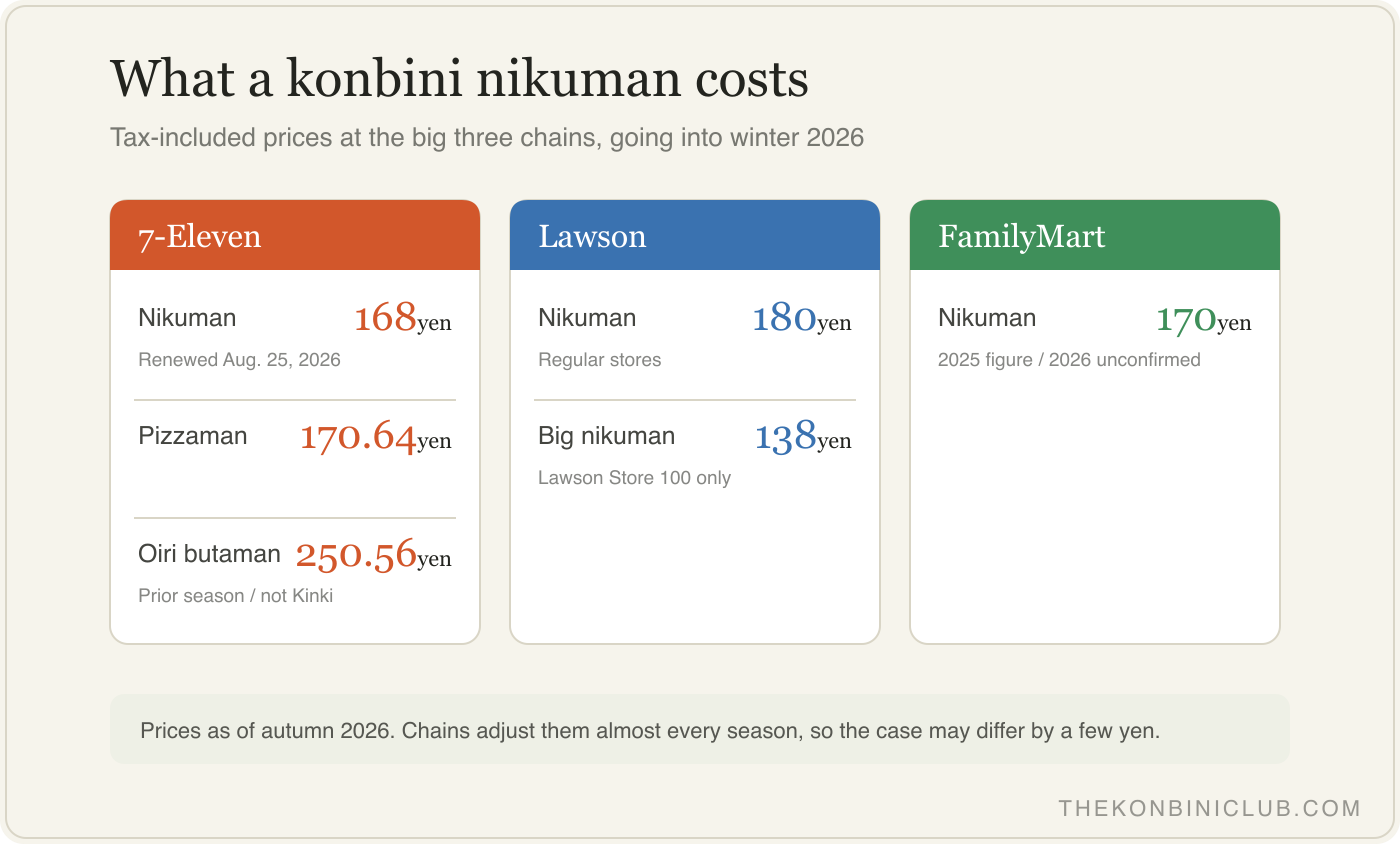
The jump that actually matters for your wallet is the one between the standard ¥168 nikuman and the bigger “oiri” butaman a size up — a step I take often enough that I think of it as the treat version. It’s not a huge premium in absolute yen, but it’s a real one, and it’s the one I’ll usually pay.
This is also a genuinely large category — the whole chukaman (steamed-bun) market in Japan runs an estimated ¥60 billion a year, with roughly 70% of that moving through convenience stores. The standard flavors don’t usually get overhauled often, but when a chain does refresh one — the way 7-Eleven just did in late August — the price tends to move with it. Don’t be surprised if the number on the case by the time you read this has shifted a few yen from what’s listed above.
The sign is a better winter signal than the calendar
I’d put real money on nikuman cases filling up before the first proper cold front hits. Stores stock ahead of demand, not behind it, which means the hand-written sign is effectively a short-range weather forecast written by convenience store logistics teams a few days before the air actually turns.
There’s an even more specific marker buried in the calendar: January 25 is officially “Chukaman Day” (中華まんの日) in Japan, set by the industry association for heated steamed foods to commemorate the coldest temperature ever recorded in the country — minus 41°C, in Asahikawa, Hokkaido, back in 1902. The idea, as far as I can tell, is pretty literal: pick the coldest day on record and use it to remind everyone that a hot bun exists. It’s a strange thing to build a food holiday around, but Japan has stranger ones.
What I’d skip: the condiments
The register will often offer you a small packet of karashi (Japanese mustard) with a nikuman, and in western Japan some people add a splash of vinegar-soy too. Skip both, at least the first time. The filling is already seasoned, and the whole point of the bun is that soft, slightly sweet dough against a savory center — sauce on top mostly just adds salt. If you try it plain and still want the mustard, fine, but give the bun one honest bite on its own first.
One practical note: a steamed bun is at its best right out of the warming case, while the dough is still soft and moist. Eat it soon after buying rather than carrying it home for later.
The one sauce I did love
For someone who eats nikuman plain, I have one sauce exception from childhood. There was a sauce at Mister Donut’s yum cha counter when I was in elementary school — a sweetish, soy-and-vinegar glaze that came with the steamed dim sum items — that I was genuinely obsessed with as a kid. I haven’t checked whether it’s still on the menu anywhere, and I wouldn’t want to send anyone chasing a sauce that might not exist anymore. But it’s the kind of detail that sticks: not the bun itself, just one specific sauce, decades later.
Getting the experience if you’re not in Japan
A fresh, steaming-hot nikuman doesn’t travel — it’s a same-day, eat-it-now food, in the same category as the fried chicken sitting under the heat lamp a few steps over, or the oden that used to simmer in a pot by the register. What does ship is the adjacent, shelf-stable version of the experience: frozen or vacuum-packed Chinese-style steamed buns show up at most well-stocked Asian grocery stores outside Japan, and a bamboo steamer is a one-time, cheap purchase if you want to make the real thing at home. Our snack starter list covers where to source the shelf-stable side of a konbini spread, and if you’d rather have someone else curate a box of the real stuff, our comparison of Sakuraco, TokyoTreat, and Bokksu is the place to start — though, like oden, nikuman is too perishable a category for any subscription box to ship as-is.
I still can’t tell you exactly when the case near my office will fill up this year. I can tell you it’ll happen before I think I need it to, and that when it does, I’m buying the pizzaman first.
— Sen
The Konbini Hit List (Free)
The 25 snacks Japanese people actually buy — printable, with what to order online when you can't fly to Tokyo.
Get the hit list →