Drink Guides
Amazake: Why Japan's Convenience Stores Sell a 'Summer' Drink All Winter
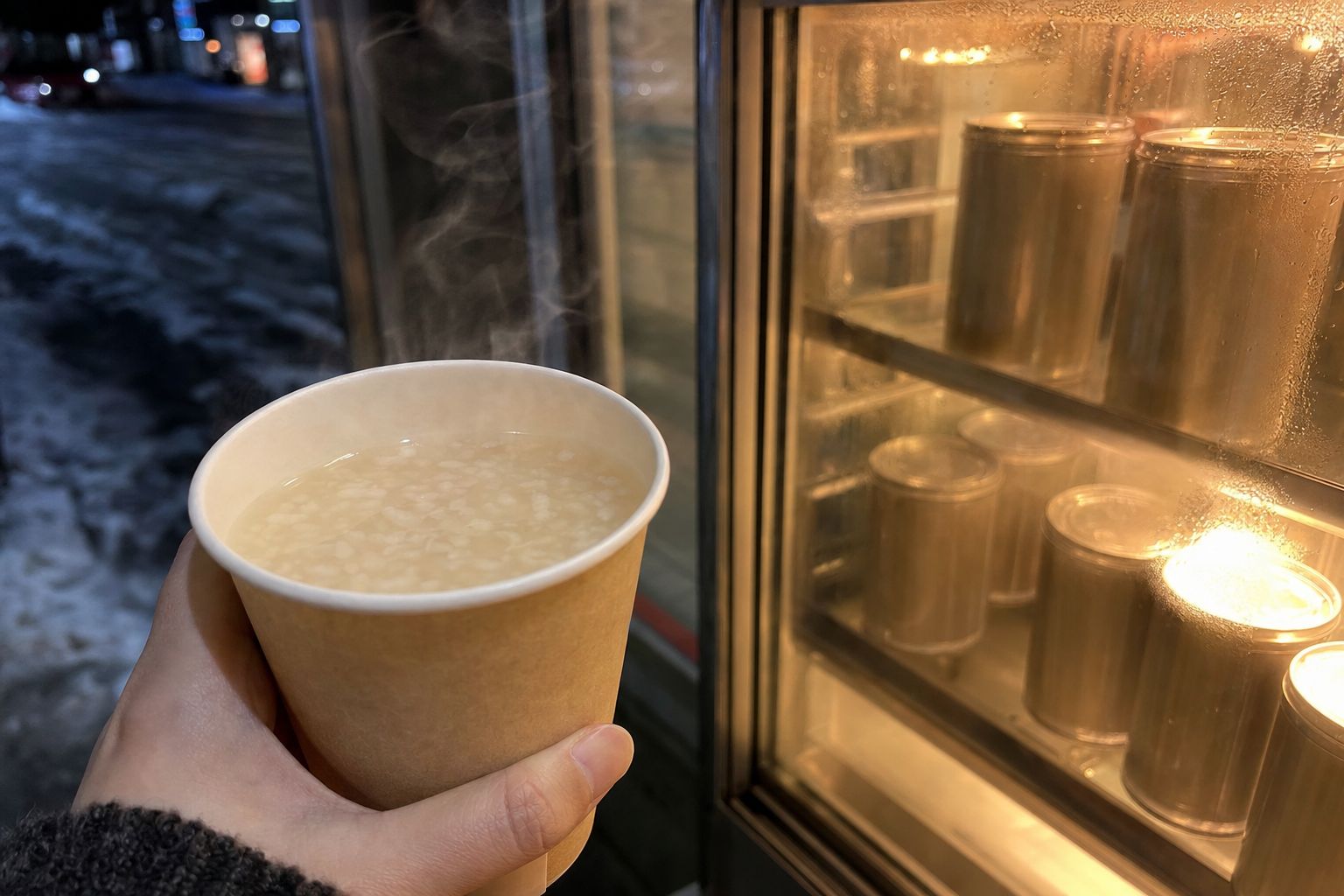
Walk into pretty much any konbini in Japan from now through New Year’s, and there’s a thick, cloudy can sitting in the heated case next to the coffee and the corn potage. It looks like rice porridge that got loose. It tastes like liquid mochi with a faint sourness underneath. And it has one of those backstories that makes you want to ask whoever decided this drink belongs to winter whether they ever read a history book.
The short version: amazake is a sweet, lightly fermented rice drink that convenience stores stock hot through the cold months and shrines hand out free at New Year’s — but for most of its history it was a summer drink, sold by street vendors as a cheap nutrition boost against the heat. Two completely different production methods get sold under the same name, and only one of them is something you’d actually want to hand to a kid or a pregnant coworker. Here’s how to tell them apart, and what’s actually worth trying.
Two drinks wearing one name
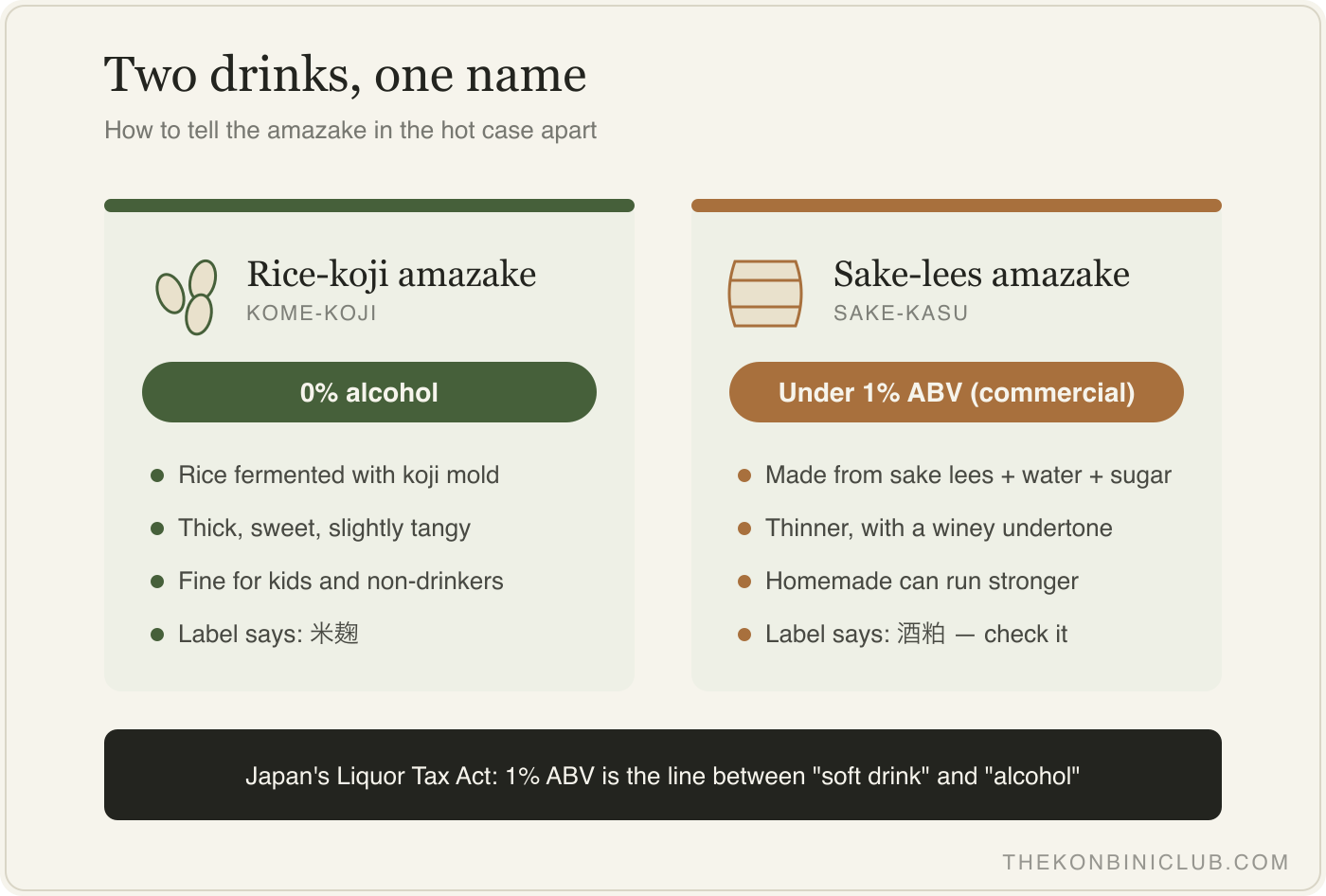
“Amazake” covers two different products, and the can doesn’t always make the difference obvious.
Rice-koji amazake (米麹甘酒) is rice fermented with koji mold — the same culture used to make miso and soy sauce — until the starches break down into natural sugar. No alcohol is produced at any point. It’s sweet, slightly tangy, and closer to a thick, warm rice milk than anything boozy.
Sake-kasu amazake (酒粕甘酒) starts from the leftover lees pressed out of actual sake production, thinned with water and sugar. Because it’s built from sake byproduct, it can carry real alcohol — Japan’s Liquor Tax Act defines anything at 1% ABV or above as an alcoholic beverage, full stop. Commercial brands get around this by heating the lees to boil off most of the alcohol and diluting the rest, which is why a can of Morinaga’s amazake is legally classified as a soft drink (清涼飲料水), not booze. Home-brewed sake-kasu amazake, simmered less carefully, can land closer to the opposite side of that 1% line.
If you’re buying it for a kid, someone pregnant, or anyone who just doesn’t drink, the label tells you what you need to know: 米麹 (kome-koji) means truly alcohol-free. 酒粕 (sake-kasu) means check the fine print, or just grab the koji one instead. That’s the one I’d actually reach for regardless — not because the sake-kasu version is dangerous at commercial strength, but because there’s no upside to guessing when the other can tells you plainly that it’s zero.
Why it’s suddenly everywhere right now
Two brands dominate the shelf, and they’re not really competing for the same drinker.
| Brand | Format | Base | What’s notable |
|---|---|---|---|
| Morinaga (森永製菓) | 190g steel can, built for the hot case | Sake-kasu, with some recent lines blending in rice koji | On shelves since October 1974 — the can most people picture when they hear “amazake” |
| Marukome (マルコメ) | 125ml–1,000ml shelf-stable paper cartons | Rice koji only | Markets itself specifically on being alcohol-free, with seasonal flavors rotating in alongside the plain one |
Morinaga’s can is the one that gets credit for making amazake a convenience-store staple in the first place, and that 1974 launch date means it’s been sitting in that warmer case through more winters than most of the chains selling it have existed. Marukome’s cartons are the newer, more deliberately “healthy drink” pitch — no heat case required, no alcohol ambiguity to explain to a customer.
The “drinkable IV drip” thing
You’ll see amazake described in Japanese media as 飲む点滴 — “a drinkable IV drip.” It’s a catchy nickname, not a medical claim, and I want to be upfront that I’m not a doctor and nothing here is health advice.
What’s actually true: rice koji breaks the grain’s starch down into glucose during fermentation, so the sugar in amazake is already predigested in a sense — your body doesn’t have to do much work to use it. The drink also carries B vitamins (B1, B2, B6, niacin) from the koji itself. That’s a real nutritional profile, not nothing. It is also, notably, a sugary drink, and most of the Japanese health writing on amazake includes the same caveat: don’t go past roughly 200g a day, and if you’re watching blood sugar for any reason, this isn’t the neutral choice it sounds like.
It used to be a summer drink. Seriously.
Here’s the part that should bother the “cozy winter drink” branding more than it does: amazake is one of the traditional summer season words (夏の季語) in Japanese haiku, and for a reason that has nothing to do with poetry. In the Edo period, amazake sellers worked the streets specifically in summer, pushing it as a cheap energy drink against natsubate — heat exhaustion — long before anyone had bottled electrolyte drinks to do the job instead. The sugar-and-B-vitamin combination that gets called a “drinkable IV drip” today is the same one that made it a plausible summer pick-me-up three centuries ago.
Somewhere in the twentieth century the drink quietly swapped seasons, and the hot can in a winter vending machine is really just the same nutrition pitch wearing a different coat.
Where it actually shows up at New Year’s
If you want to see amazake doing its most Japanese thing, skip the convenience store and go to a shrine on January 1st through 3rd, during hatsumode — the first shrine visit of the new year. A number of shrines and temples hand out free hot amazake to visitors standing in the cold waiting to pray. It’s not universal and not guaranteed at every location, so it’s worth checking a specific shrine’s plans before you go expecting a free cup — but if you stumble into it, that’s the drink at its most traditional, served exactly the way it would have been a century ago.
Konbini amazake and shrine amazake are, functionally, the same product serving two different jobs: one keeps cold hands warm during a five-minute wait in line, the other keeps commuters caffeinated-but-not-actually-caffeinated on their way to work in December.
Getting it outside Japan
The “hot” part doesn’t travel — same as the hot canned soup sitting next to it, the warmer case is the whole experience. The drink itself ships fine, because the commercial versions are shelf-stable: Morinaga and Marukome both sell amazake through Japanese grocery importers and specialty online shops, in the same can or carton you’d find at a konbini register. Our snack starter list covers where to find shelf-stable Japanese staples generally, and if you’d rather have a curated box do the finding for you, our comparison of Sakuraco, TokyoTreat, and Bokksu is a reasonable starting point — though check the box contents first, since amazake isn’t guaranteed in any given month’s selection.
For what else is warming up in that same case this season, our konbini coffee guide covers the can next to it, and if you’re already planning for the New Year’s run, our Christmas cake preorder guide covers the other seasonal rollout happening at the same three chains right now.
If you only try one, make it a rice-koji can or carton: zero alcohol, nothing to double-check on the label, and it’s the version closest to what those Edo street vendors were selling. A drink that talked its way from “street vendor’s summer cure” to “shrine’s New Year’s tradition” to “hot can by the register” without ever really changing its recipe has earned one honest try.
— Sen
The Konbini Hit List (Free)
The everyday snacks people here actually buy — a printable tick-list with the Japanese name to search for when you order online.
Get the hit list →