Seasonal Guides
Konbini Christmas Cake Preorders: How Japan's Big Three Actually Run It
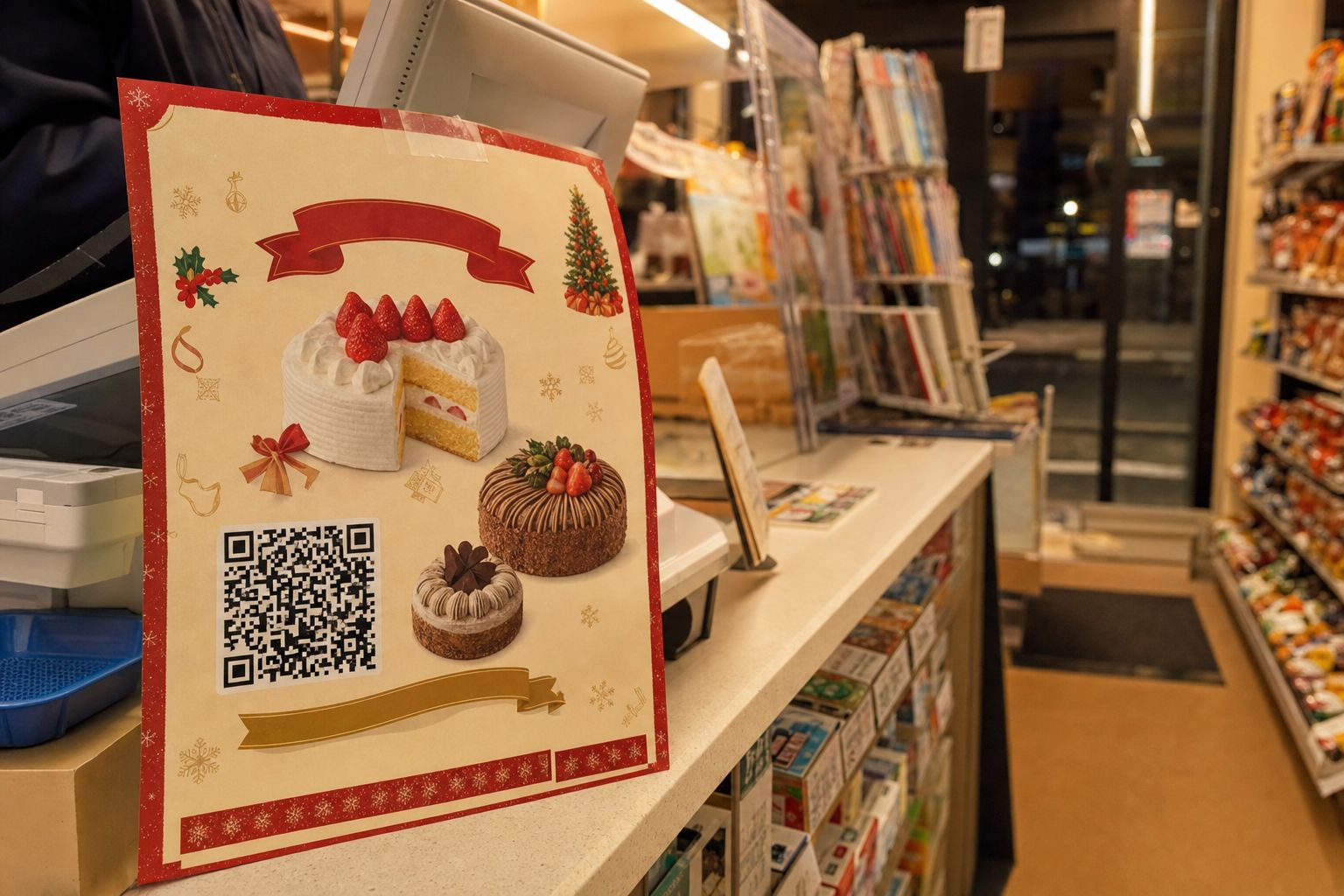
Walk into almost any 7-Eleven, Lawson, or FamilyMart in Japan right now and you’ll see a laminated flyer taped near the register with a QR code on it, months before anyone outside Japan starts thinking about Christmas. That’s not early marketing. It’s already late, relatively speaking — the preorder windows for this year’s Christmas cakes opened in mid-September, and the popular ones sell out long before December.
The short answer: all three major chains run cake preorders the same basic way — reserve in September or early October through the chain’s app or in-store, pick it up in the week before Christmas, and get a discount for booking early. The details, prices, and deadlines differ by chain, and the pickup day that actually matters isn’t the one you’d guess.
Why this starts so early
A fresh, decorated cake can’t sit in a warehouse. Convenience stores solve that the same way bakeries do: they take the order months in advance, manufacture to a forecast, and ship a known quantity straight to a known number of stores on a known date. No pot simmering by the register, no guessing how many to stock — the same logic that pushed self-serve oden out of these stores applies even harder to a cake that has to look good enough for a photo.
It also means the limited and character-collaboration cakes genuinely run out. These aren’t flexible quantities a store can reorder. Once a chain’s allocation for a given SKU is gone, it’s gone until next year.
The three preorder windows
| Chain | Reservation opens | Reservation closes | Pickup window |
|---|---|---|---|
| 7-Eleven | September 14 | varies by item (in-store or 7NOW app) | December 19–25 |
| Lawson | September 15 | December 18 at 6 p.m. (Lawson app: December 13) | December 19–25 |
| FamilyMart | September 16, 10:01 a.m. (Okinawa: October 1) | varies by item (check app for exact cutoffs) | December 20–25 |
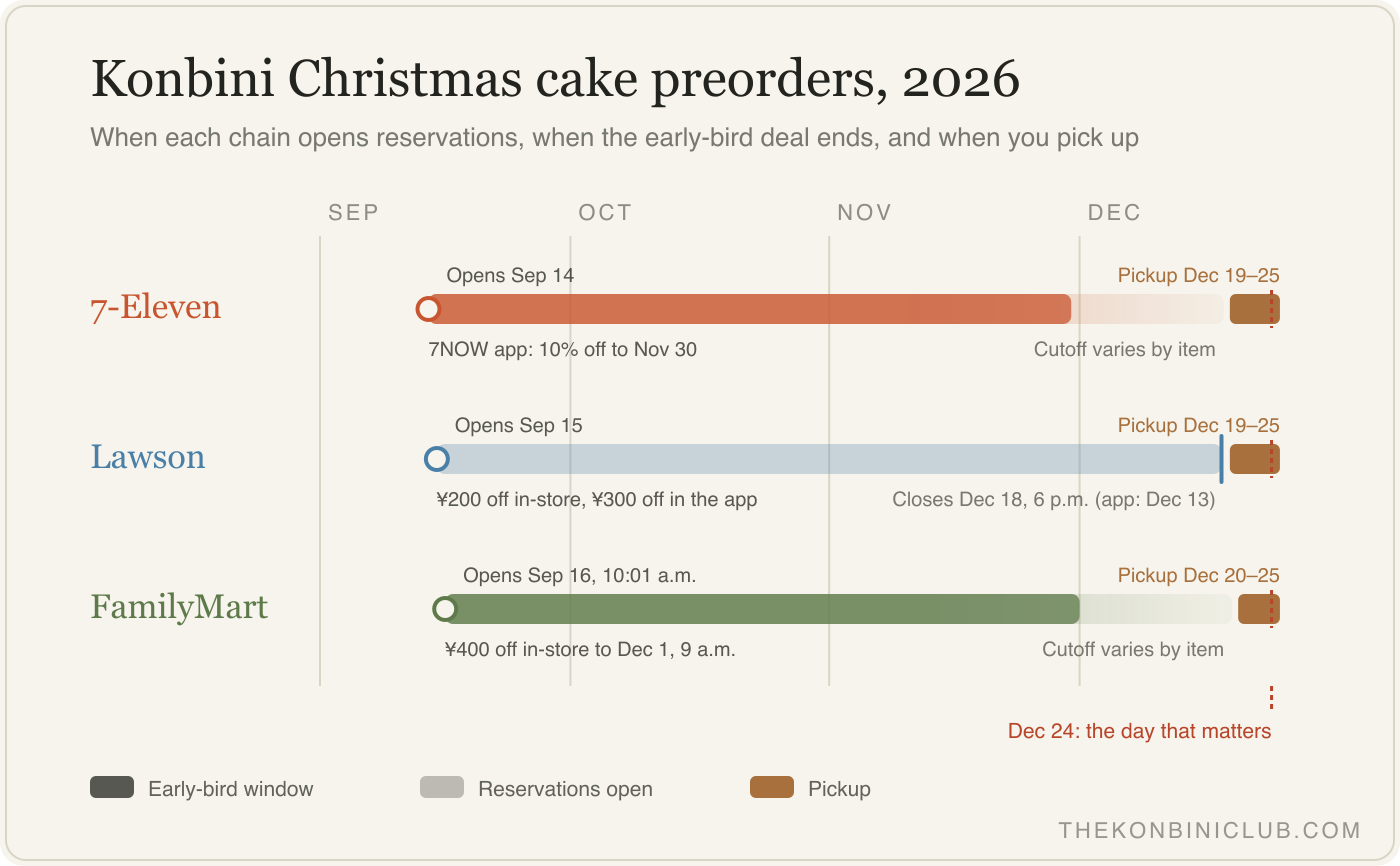
Each chain also dangles an early-bird discount to pull reservations forward, which is the part that actually explains why the flyers go up in September instead of November:
- 7-Eleven offers 10% off through its 7NOW delivery app if you reserve by the end of November.
- Lawson takes ¥200 off in-store reservations and ¥300 off if you book through the Lawson app.
- FamilyMart knocks ¥400 off in-store reservations made between its opening hour and December 1st at 9 a.m., plus extra loyalty points for orders placed through its FamiMa Online site.
None of these discounts are large on their own.
What they buy the chains is a forecast they can actually plan a factory run against, weeks before the rush. What they buy you is the specific cake you wanted, instead of whatever’s left on the shelf on the 23rd.
What’s actually in the lineup this year
Each chain runs somewhere between 30 and 70 SKUs once you count cakes, roast chicken, and sides together, so a full list isn’t useful here. The pattern that matters more is how far upmarket these have drifted.
FamilyMart brought in Pierre Marcolini, the Belgian chocolatier, for two cakes this year — a chocolate-and-caramel version and a red-fruit-and-vanilla version, both around 12cm and ¥4,600, built for two to three people. There’s also a Pierre Hermé–supervised Gâteau de Noël at ¥4,980. A convenience store selling a named-chocolatier cake at a price that would’ve seemed absurd for this channel a decade ago says something about how seriously the category is taken now.
Lawson leans into character tie-ins instead of pastry-world names — a My Melody cake and a Mrs. GREEN APPLE collaboration cake both showed up in this year’s roughly 31-item lineup, priced in the ¥4,900–5,200 range. 7-Eleven is marking a 30th anniversary for its “Christmas Kamakura” cake, a dome-shaped strawberry shortcake roughly 15cm across for ¥3,000, alongside a smaller 11cm Gateau Fraise at ¥3,500.
I’ll say the unpopular part plainly: ¥4,600 to ¥5,200 is not a small amount of money for a cake you’re picking up at a convenience store, even one with a famous name attached. A proper patisserie in Tokyo will sell you something comparable for not dramatically more, and you can taste-test it in person instead of ordering off a photo in September. The convenience store version wins on logistics — one stop, one app, guaranteed pickup near your home or station — not on being the best cake available at that price. If you live somewhere without a decent bakery nearby, that trade is an easy yes. If you’ve got options, it’s worth knowing you’re paying partly for the QR code.
The date that actually matters
Here’s the part that trips people up if they’re new to Japan: Christmas Day itself, December 25th, is an ordinary working day. No holiday, no office closure, nothing. The day the entire cake-and-chicken ritual actually centers on is December 24th, Christmas Eve — which functions here closer to how some countries treat New Year’s Eve, a date for couples and families to do something special before everyone goes back to normal the next morning.
That timing traces back to a well-known bit of marketing history: KFC Japan’s “Kentucky for Christmas” campaign in the 1970s successfully attached fried chicken to the holiday in a country with almost no Christian population and no turkey tradition, and cake slotted in alongside it as the dessert half of the same evening. Decades later, a strawberry shortcake and a bucket of fried chicken on December 24th is just what the holiday looks like here, the same way the hot case by the register does a quiet surge of its own business that same week.
That’s also why the pickup windows above run through the 25th but the real crunch hits on the 23rd and 24th. Order for pickup on the 24th if you want the full experience; order for the 25th and you’ll have a cake, just not the one that matches what’s actually happening around you that week.
Mistakes worth avoiding
- Waiting until December. The early-bird discounts expire well before Christmas, and the character-collaboration and chef-supervised cakes have a real chance of selling out by late November. If you have your heart set on a specific one, reserve it the week the preorder window opens.
- Assuming every store carries every item. Smaller or franchise-run locations sometimes carry a trimmed-down selection, and regional items (Okinawa’s later FamilyMart start date is one example) don’t travel. Check your specific store’s app listing rather than a general news article — including, honestly, this one, since prices and lineups shift slightly every year.
- Picking December 25th for pickup and expecting a Christmas Eve atmosphere. The cake will be identical. The vibe around you picking it up won’t be.
If you’re reading this from outside Japan
None of these preorder apps work with an overseas address, and a fresh cake isn’t shipping internationally regardless — that puts it in the same not-exportable bucket as the freezer case and anything else that has to be eaten the same day it’s made. What you can bring into your own kitchen is the adjacent, shelf-stable side of Japanese Christmas and New Year snacking, and our snack starter list is a reasonable place to start building that out. If a curated monthly box appeals to you more than sourcing items yourself, our comparison of Sakuraco, TokyoTreat, and Bokksu covers how those three stack up, including whether any of them lean into seasonal boxes around December.
I haven’t reserved one of these myself this year, so I won’t pretend to have an opinion on which cake is actually worth the ¥4,600. What I can tell you with more confidence is the mechanism: reserve early, pick up on the 24th if you want the real version of the holiday, and don’t expect the 25th to feel like anything in particular. It won’t. That’s kind of the point.
— Sen
The Konbini Hit List (Free)
The 25 snacks Japanese people actually buy — printable, with what to order online when you can't fly to Tokyo.
Get the hit list →