Seasonal Guides
Kairo: Japan's Convenience Store Hand Warmer That Works by Rusting on Purpose
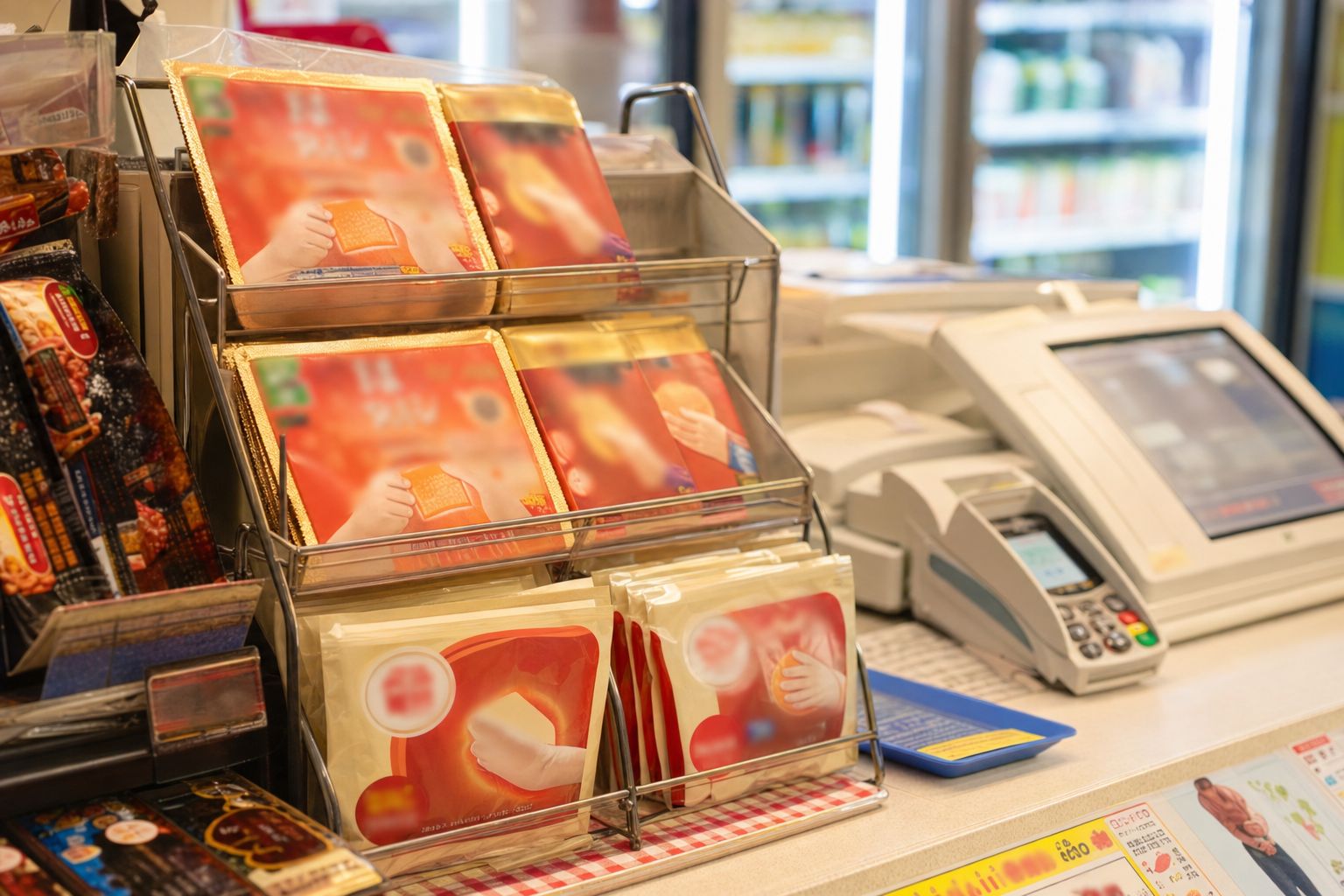
Right around the time Japanese convenience stores start pushing hot canned soup through the drink case, a second seasonal object shows up a few feet away, usually in a wire rack near the register: small foil pouches, a few hundred yen a box, that get warm on their own the second you tear the outer wrapper open. No battery, no microwave, no flame. You shake it, or you don’t even need to, and within a couple of minutes it’s warmer than your hand.
The short version: kairo (カイロ) are Japan’s disposable hand warmers, and the heat comes from iron rusting on purpose, fast, inside a sealed pouch, with salt and water and air as the ingredients that make it happen quickly instead of over the years it normally takes a nail to go orange. There are two incompatible types — one you stick to your clothes, one you hold or stuff in a pocket — and they’re not sized or dosed the same way. The convenience-store ones are the mass-market descendant of a much older, reusable device that Japan still sells today for people who want it the old way.
Where this actually started
The pouch at the register isn’t the original kairo. Japan’s hand warmers trace back to 1923, when Niichi Matoba is credited with inventing the hakkin-kairo (白金カイロ) — a small metal case that burns lighter fluid against a platinum catalyst, no open flame, refillable and reusable for years. The company that made it is still around and still sells essentially the same product, which tells you something about how well the original design worked.
The disposable version most people mean when they say kairo — iron powder in a paper pouch, thrown away once it’s cold — is newer, developed from around the mid-1970s. It solved the two things the platinum version never could: price and friction. A reusable metal hand warmer needs lighter fluid, a lighter, and a little patience to get it going. A disposable one needs you to tear a wrapper.
That’s the whole reason it ended up at a convenience store register and the platinum version didn’t.
The chemistry, in plain terms
Open the outer wrapper and you’re exposing the iron powder inside to oxygen for the first time. Iron plus oxygen plus water is rust, and rust is an exothermic reaction — it gives off heat as it happens. A fresh nail does this too, just slowly enough over months that you’d never notice the warmth.
Kairo speeds that up with salt, which acts as a catalyst, plus activated carbon and vermiculite, a mineral that holds water and releases it gradually so the reaction doesn’t peak in thirty seconds and die. The inner pouch itself is made of air-permeable paper so the reaction can actually breathe once it starts, and that’s exactly why the sealed foil outer wrapper matters: no oxygen reaches the iron until you tear that outer layer open. Leave the inner pouch sitting out in the air and it’ll run its whole reaction whether you wanted heat right then or not.
Stick-on and hold-type aren’t the same product
This is the part that trips people up if they’ve only ever bought one kind. Japanese drugstores and convenience stores carry two distinct lines, and swapping one for the other doesn’t work the way you’d expect.
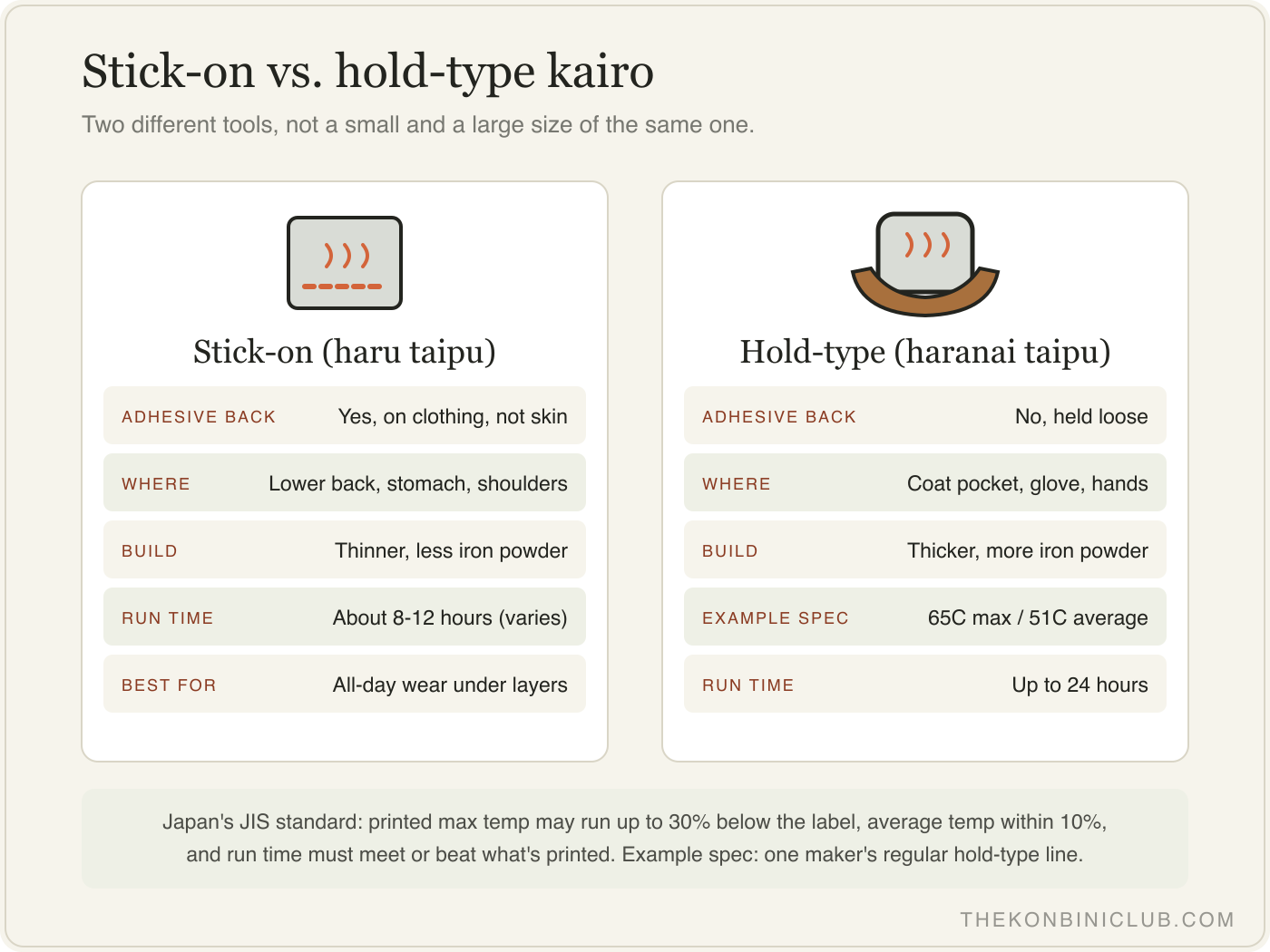
The stick-on type (貼るタイプ, haru taipu) has an adhesive back and is built to go against the inside of clothing, not skin — lower back, stomach, between the shoulder blades. It’s made thinner, with less iron powder packed in, and that mostly shows up as a shorter run time than the hold-type — commonly somewhere in the 8-to-12-hour range for a standard pack, though it varies by product line — rather than a wildly different peak temperature.
The non-stick, hold-in-your-hand type (貼らないタイプ, haranai taipu) is thicker, carries more iron powder, and runs hotter and longer — Kiribai’s own regular-line listing specs a 65-degree maximum and a 51-degree average over 24 hours. This one is built to ride loose in a coat pocket or a glove, closer to a tool you hold than something you wear.
Neither one is a smaller or bigger version of the other. They’re tuned for different jobs, and Japan’s industrial standard for the category (JIS) actually regulates how far the printed numbers are allowed to drift from reality — the labeled max temperature can run up to 30% below what’s printed, the average temperature within 10%, and the run time has to meet or beat what’s on the box.
The brand behind the pouch at the register
Kiribai (桐灰) is the name you’ll see most often on Japanese kairo packaging, and it’s got its own strange continuity with the pre-disposable era. The company started in 1915 as 桐灰化学, originally making the ash used inside older charcoal-based warmers — the thing kairo meant before iron powder took over. It became a subsidiary of Kobayashi Pharmaceutical in 2001, and the two names now effectively run the category together in Japan.
If you’re trying one for the first time, the stick-on type worn over a shirt on the lower back is the easiest place to start. It’s the use the adhesive packs are built around, and it keeps your hands free for the coffee you probably also bought at the register.
After it’s cold: what to do with a dead kairo
A used kairo that’s gone cold isn’t going to reheat, and it won’t catch fire sitting in the trash — the reaction only runs forward once, and once the iron’s oxidized it’s done.
That doesn’t mean it’s only good for the bin, though. The activated carbon inside keeps most of its absorbing power after the heat reaction finishes, which is why you’ll see Japanese household tip sites suggest sealing a spent kairo inside a shoe overnight — one per shoe, roughly 24 to 48 hours sealed up — as a decent deodorizer. Researchers at Tokyo University of Marine Science and Technology took the same leftover iron-and-carbon mix further: packed into small balls nicknamed “iron-charcoal dumplings,” it was used in an outdoor experiment to help clear sludge out of Tokyo’s Meguro River, with most of the accumulated muck reportedly gone within about three months. Kobe city has also run a pilot program collecting used kairo rather than sending them straight to the regular trash stream.
None of that means you should skip your own municipality’s sorting rules — Japan’s local governments don’t agree on whether a spent kairo counts as burnable or non-burnable waste, and that’s a real, boring, city-by-city difference worth checking once rather than guessing.
I’m not a doctor, but the safety point worth repeating is the one on the box: don’t tape a kairo directly against bare skin, and don’t fall asleep with one on. Japan’s product-safety testing body has documented low-temperature burns forming from contact as mild as 44 degrees Celsius if it sits against the same patch of skin for three or four hours straight — well under what feels “hot” at any given moment, which is exactly why people get caught out by it, especially anyone with reduced skin sensation or anyone who’s simply out cold asleep. Running water over it afterward doesn’t do much; if it’s actually sore or discolored, that’s a reason to see someone, not wait it out.
Getting the experience if you’re not in Japan
A kairo doesn’t have a texture or a flavor, so it skips the “can’t ship it” problem that a fresh Christmas cake or a bowl of convenience-store oden runs into — several Japanese brands, Kiribai included, do turn up through importers and general marketplaces outside Japan, foil wrapper and all. If you’d rather have the whole seasonal konbini spread curated for you instead of hunting down one specific item, our comparison of Sakuraco, TokyoTreat, and Bokksu is a reasonable next stop, though none of the three boxes are built around hand warmers specifically — they’re snack-first.
It’s a plain paper pouch doing a chemistry-class reaction on purpose, sold by the hundreds of millions every winter according to the industry association’s own shipment figures, in a country that also makes a reusable platinum version nobody threw out a hundred years later. Both are still on the shelf. Only one of them asks nothing more of you than tearing a wrapper.
Omae wa mou… hamatteiru. (You’re already hooked. Nani?!)
— Sen
The Konbini Hit List (Free)
The everyday snacks people here actually buy — a printable tick-list with the Japanese name to search for when you order online.
Get the hit list →